



SVP, North America


When the SEC delayed the major Form PF structural changes to October 2026, much of the industry interpreted it as a temporary pause. More time to prepare, more time to plan. Perhaps even more time to wait. But a closer look at the SEC’s latest Annual Staff Report on the Use of Form PF Data suggests a few more subtleties. The reality is that Form PF has already evolved, not only in its format, but in how it is used. And that shift has implications far beyond the US.
You file Form PF. Regulators analyse it.
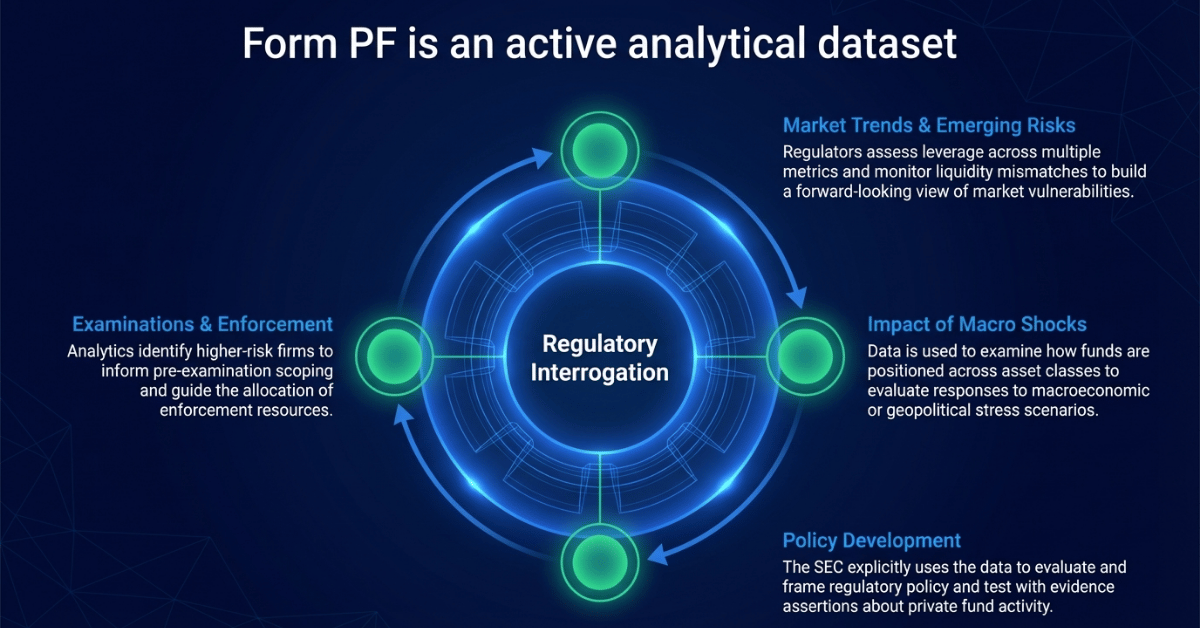
An eye-opening aspect of the SEC report is how explicitly it describes the role Form PF now plays internally. Form PF data is not simply collected and stored. It is actively used in four distinct areas:
Market trends and emerging risks
It helps identify market trends and emerging risks, for example, by assessing leverage across multiple metrics, monitoring liquidity mismatches and analyzing how exposures evolve across strategies and market conditions. In practice, this allows regulators to build a forward-looking view of where vulnerabilities may be building across the private fund ecosystem.
Impact of market and geopolitical events
It enables the regulators to assess the impact of market and geopolitical events, by examining how funds are positioned across asset classes and markets, allowing them to evaluate how different segments of the industry may respond to macroeconomic shocks or geopolitical stress scenarios. This type of analysis helps build a more systemic view of potential vulnerabilities across the market.
Policy development and regulatory decisions
The regulators use Form PF data to identify trends, test assumptions about private fund activity and evaluate the potential impact of regulatory policy choices. In that sense, Form PF is not just informing supervision, it is also shaping the direction of future regulation.
Examinations and enforcement activity
The regulators analyze Form PF data to identify higher-risk firms, inform pre-examination scoping and guide the allocation of supervisory and enforcement resources. This means filings are not just reviewed. They help determine where regulators look more closely.
The report even notes that Form PF enables the SEC to “evaluate and frame regulatory policy” and “test with evidence assertions about private fund activity”. In other words, Form PF is not just a regulatory requirement. It is an analytical dataset. Or, put more simply: firms submit data and regulators interrogate it.
From visibility to intelligence
The original purpose of Form PF was to give regulators visibility into private markets. Before its introduction, the SEC itself acknowledges it had “limited visibility into this economic activity”. Today, that has changed materially.
The report highlights how Form PF data is now combined with other datasets and analyzed using automated tools, all that with the aim to identify “outliers” based on performance, exposure and liquidity and to share the insights across regulatory bodies including the CFTC, Federal Reserve and FSOC.
It also notes that regulators can now assess leverage through multiple metrics, liquidity mismatches, derivatives usage and broader market exposures… This is no longer about transparency alone, but regulatory intelligence.
Data quality is no longer a back-office concern
Another subtle but important signal in the report is the emphasis on data accuracy and completeness. The SEC notes that it contacts firms when it detects “anomalous and possibly erroneous data”, follows up on delinquent or missing filings and has taken further steps, including enforcement, where issues persist.
It also highlights the use of automated tools to flag inconsistencies and support risk-based analysis. This reflects a broader shift. When data is used for analysis and not just record-keeping, its quality becomes critical. Small inconsistencies are no longer isolated issues. They can distort trend analysis, trigger regulatory scrutiny or raise questions during examinations.
A global implication: regulators are thinking in systems, not forms
While Form PF is a US requirement, the model behind it is not uniquely American. The report repeatedly highlights coordination across US regulators, with international organisations and through shared datasets and analytical frameworks. For example, Form PF data is made available to the Financial Stability Oversight Council (FSOC) and used alongside other regulatory datasets to assess systemic risk.
And this mirrors what we are seeing elsewhere. In Europe, Form PF’s cousin AIFMD Annex IV continues to evolve toward greater transparency and granularity. Cross-border managers increasingly face overlapping obligations. And regulators are building a more connected view of fund activity.
This is the current and future direction of travel: regulation is becoming data-centric, interconnected and analytical.
The quiet shift firms are still catching up to
What’s interesting is that many firms haven’t fully adjusted to this shift. Form PF is still often treated as a periodic reporting exercise, a standalone obligation or a process managed in isolation from other filings. But regulators are no longer treating it that way. They are connecting datasets, comparing filings over time and using analytical tools to identify patterns and anomalies at scale
This creates a gap between how firms produce regulatory data… and how regulators consume it.
The opportunity behind the delay
Seen in this light, the October 2026 delay takes on a different meaning. While it gives firms additional time to prepare for structural changes like disaggregation or new identifiers, it is also an opportunity to rethink how regulatory data is managed altogether.
Because the real challenge is no longer “Can we file Form PF correctly?”, but increasingly “Can we produce consistent, connected decision-grade data across all our regulatory obligations?”
While the October 2026 timeline has shifted, some elements of the future state are already taking shape. FINRA’s release of the “final” XML schema” on March 2, 2026, serves as a critical technical milestone for the Form PF reporting transition. This update provides the structural requirements of the revised Form PF Section 1-4 schema for filers who upload Form PF as an XML file ahead of the October 1, 2026 compliance deadline. This technical update provides firms with:
- Structural certainty: it establishes the “final” technical specifications, allowing fund managers and technology vendors to finalize their data builds and internal reporting systems.
- Compliance alignment: this schema is a by-product of previous extensions and is designed to support the broader transition to structured data reporting.
- Enhanced data utility: by moving to this structured XML format, the SEC aims to streamline data entry, reduce errors and improve the comparability of filings across the industry.
In other words, while there may still be some uncertainty around timing, there is far less uncertainty around direction.
Final thought
Form PF hasn’t become more demanding because of a new deadline. It has become more important because of how it is used. The shift from filing to analysis is already underway, and it is likely to define the next phase of regulatory reporting globally, not just in the US.
From reporting to intelligence
If regulatory data is no longer just filed but actively analysed, the way it is managed needs to evolve too.
At AQMetrics, we help firms move beyond siloed reporting processes toward a more connected, data-driven approach, where information captured for Form PF can be reused across frameworks like AIFMD Annex IV or CPO-PQR, with consistency and control built in.